
- Technology
The human eye can only detect wavelengths in the visible light range, but a new imaging system will let us "see" infrared radiation using smartphones.
When you purchase through links on our site, we may earn an affiliate commission. Here’s how it works.
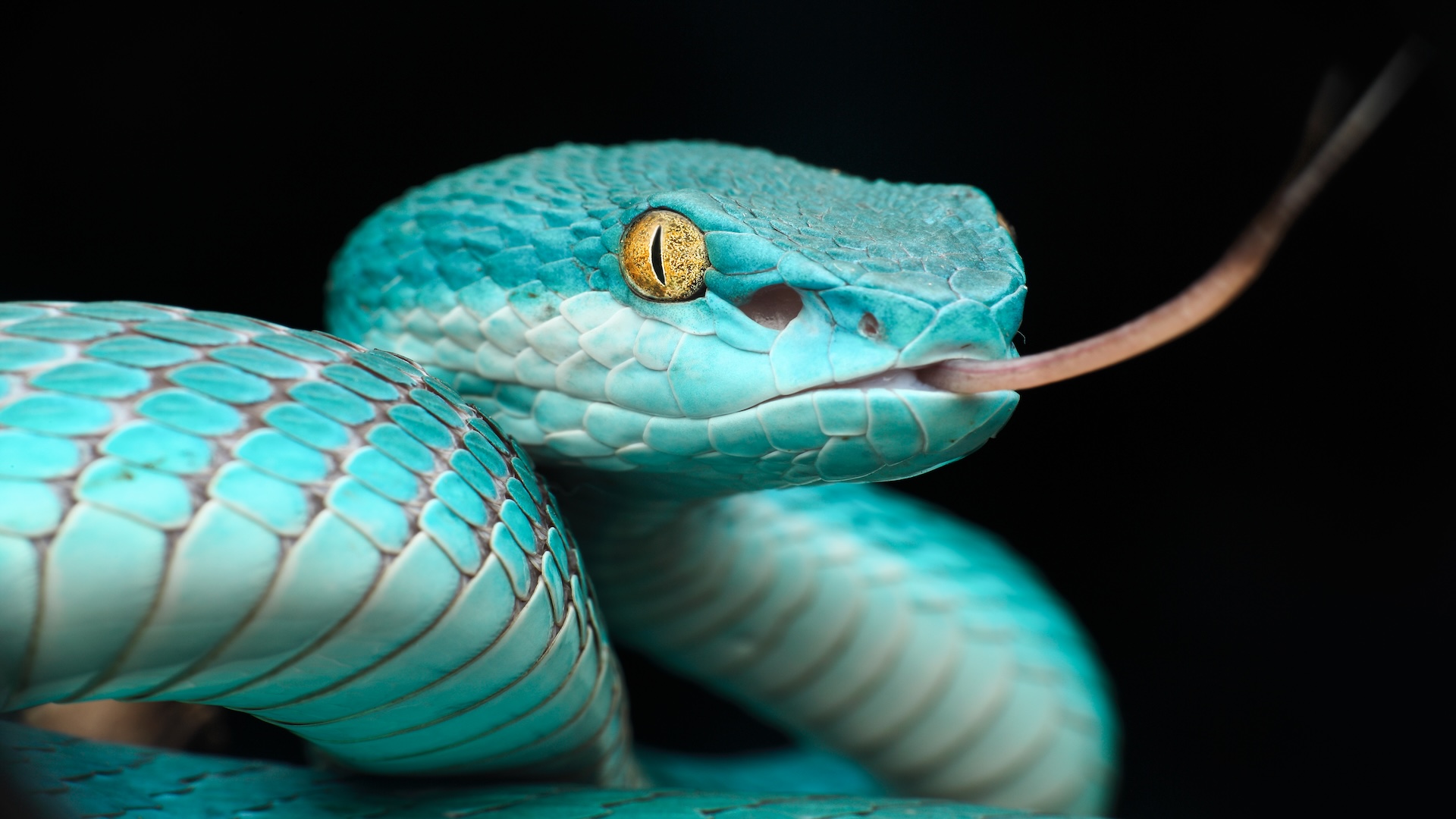 The new artificial imaging system will let us sssssssssee clearly through rain and fog!
(Image credit: Getty Images)
Share
Share by:
The new artificial imaging system will let us sssssssssee clearly through rain and fog!
(Image credit: Getty Images)
Share
Share by:
- Copy link
- X
Scientists in China have developed a first-of-its-kind artificial imaging system inspired by snakes that are able to "see" heat coming off their prey in total darkness. The sensor captures ultra-high-resolution infrared (IR) images in 4K resolution (3,840 × 2,160 pixels) — matching the image quality of the iPhone 17 Pro's camera.
Any object with a temperature above absolute zero (-460 degrees Fahrenheit or -273 degrees Celsius) emits some electromagnetic radiation. For normal body heat, this has a wavelength in the IR range. The human eye can only pick up shorter wavelengths that are in the visible light range.
Snakes can also see visible light — but some species, such as pit vipers (Crotalinae), also have a special heat-sensing organ just next to their nostrils that allows them to visualize longer wavelength IR radiation.
You may like-
 Scientists create ultrapowerful, squishy robotic 'eye' that focuses automatically and doesn't need a power source
-
 Scientists create world's first microwave-powered computer chip — it's much faster and consumes less power than conventional CPUs
-
 Venomous snake strikes captured in extreme detail through high-speed videos for first time
It is called a "pit" organ as it comprises a hollow chamber with a thin membrane suspended across it. When IR waves heat specific areas of the membrane, a thermal "image" is sent to the brain via the attached nerves.
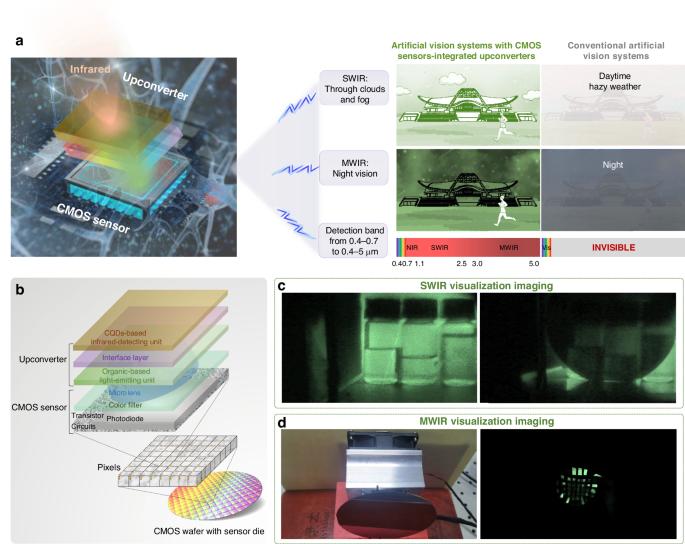
Scientists from the Beijing Institute of Technology used this concept to create their own IR detecting system. They stacked layers of different materials on an 8-inch disc, through which the radiation passes until it manifests as a high-quality image visible to the human eye. The system was outlined in a study published Aug. 20 in the Nature journal Light: Science & Applications.
The first layer of the imaging system is an IR sensing layer, formed of so-called "colloidal quantum dots" — tiny nanoparticles made from mercury and tellurium atoms that release electrical charges when they absorb IR radiation. The charges then travel through several noise-reducing layers to an organic light-emitting diode (LED) layer known as the "upconverter."
Here, the electrons meet "holes" (absences of electrons) and release energy, which phosphorescent molecules convert to green, visible light. Finally, the visible light meets the "complementary metal oxide semiconductor" (CMOS) layer and is converted into an image.
Sign up for the Live Science daily newsletter nowContact me with news and offers from other Future brandsReceive email from us on behalf of our trusted partners or sponsorsBy submitting your information you agree to the Terms & Conditions and Privacy Policy and are aged 16 or over.
IR vision in future smartphones and cameras
This is the first system that can turn short and mid-wave IR (wavelengths of 1.1 to 5 micrometers) into an ultra-high-resolution image at room temperature. Because the CMOS sensor is directly on top of the upconverter, weaker IR signals are captured before noise can drown them out. In other systems, where the CMOS and upconverter are separated, costly cryogenic cooling is required to prevent noise buildup as the signals travel between them.
Being able to see IR radiation effectively extends the range of wavelengths visible to humans by more than 14 times. A camera fitted with the sensor’s technology will be able to detect warm objects in conditions with low light, such as in fog, through smoke or at night.
related stories—China creates powerful spy satellite capable of seeing facial details from low orbit
—Flat, razor-thin telescope lens could change the game in deep space imaging — and production could start soon
—Tiny, transparent chip could transform your smartphone into a professional-grade camera
"The extended artificial vision into infrared range could operate in all weather, whether day or night, regardless of extreme weather, and be of use in new fields such as industry inspection, food safety, gas sensing, agricultural science, and autonomous driving,” the researchers wrote in the study.
They added that tens of millions of pixels using their system "could be achieved at an extremely low cost," making the technology more feasible for consumer cameras and smartphones in the future.
Indeed, these devices already use standard silicon CMOS sensors upon which the layers could be attached.
 Fiona Jackson
Fiona Jackson is a freelance writer and editor primarily covering science and technology. She has worked as a reporter on the science desk at MailOnline, and also covered enterprise tech news for TechRepublic, eWEEK, and TechHQ.
Fiona cut her teeth writing human interest stories for global news outlets at the press agency SWNS. She has a Master's degree in Chemistry, an NCTJ Diploma and a cocker spaniel named Sully, who she lives with in Bristol, UK.
Show More CommentsYou must confirm your public display name before commenting
Please logout and then login again, you will then be prompted to enter your display name.
Logout Read more Scientists create ultrapowerful, squishy robotic 'eye' that focuses automatically and doesn't need a power source
 Scientists create world's first microwave-powered computer chip — it's much faster and consumes less power than conventional CPUs
Venomous snake strikes captured in extreme detail through high-speed videos for first time
Scientists create world's first microwave-powered computer chip — it's much faster and consumes less power than conventional CPUs
Venomous snake strikes captured in extreme detail through high-speed videos for first time
 China solves 'century-old problem' with new analog chip that is 1,000 times faster than high-end Nvidia GPUs
 Tiny implant 'speaks' to the brain with LED light
 'Rainbow-on-a-chip' could help keep AI energy demands in check — and it was created by accident
Latest in Technology
'Rainbow-on-a-chip' could help keep AI energy demands in check — and it was created by accident
Latest in Technology
 Scientists build 'most accurate' quantum computing chip ever thanks to new silicon-based computing architecture
 Graphene supercapacitor breakthrough could boost energy storage in future EVs and other household devices
 New EV motor invention could cut 1,000 pounds from future vehicles, making them much lighter while boosting their range
 Japan laser weapon trial, comet 3I/ATLAS bids farewell, and AI solves 'impossible' math problems
 Save 72% with our exclusive Norton VPN deal and get set for travel over the holidays and into 2026
 Japan trials 100-kilowatt laser weapon — it can cut through metal and drones mid-flight
Latest in News
Japan trials 100-kilowatt laser weapon — it can cut through metal and drones mid-flight
Latest in News
 18,000 years ago, ice age humans built dwellings out of mammoth bones in Ukraine
 Earth's seasons vary wildly, even at the same latitude, new research finds
 Cats meow more at men to get their attention, study suggests
 2,300-year-old Celtic gold coins found in Swiss bog
Tiny implant 'speaks' to the brain with LED light
2,300-year-old Celtic gold coins found in Swiss bog
Tiny implant 'speaks' to the brain with LED light
 3,300-year-old cremations found in Scotland suggest the people died in a mysterious catastrophic event
LATEST ARTICLES
3,300-year-old cremations found in Scotland suggest the people died in a mysterious catastrophic event
LATEST ARTICLES- 1Earth's seasons vary wildly, even at the same latitude, new research finds
- 218,000 years ago, ice age humans built dwellings out of mammoth bones in Ukraine
- 3Tiny implant 'speaks' to the brain with LED light
- 4Cats meow more at men to get their attention, study suggests
- 5See the 100,000th photo of Mars taken by NASA's groundbreaking Red Planet orbiter