- Archaeology
These Anglo-Saxon accessories were recovered from the side of a hill in England and may be from a hoard, a ritual deposit or a collection of stolen items.
When you purchase through links on our site, we may earn an affiliate commission. Here’s how it works.
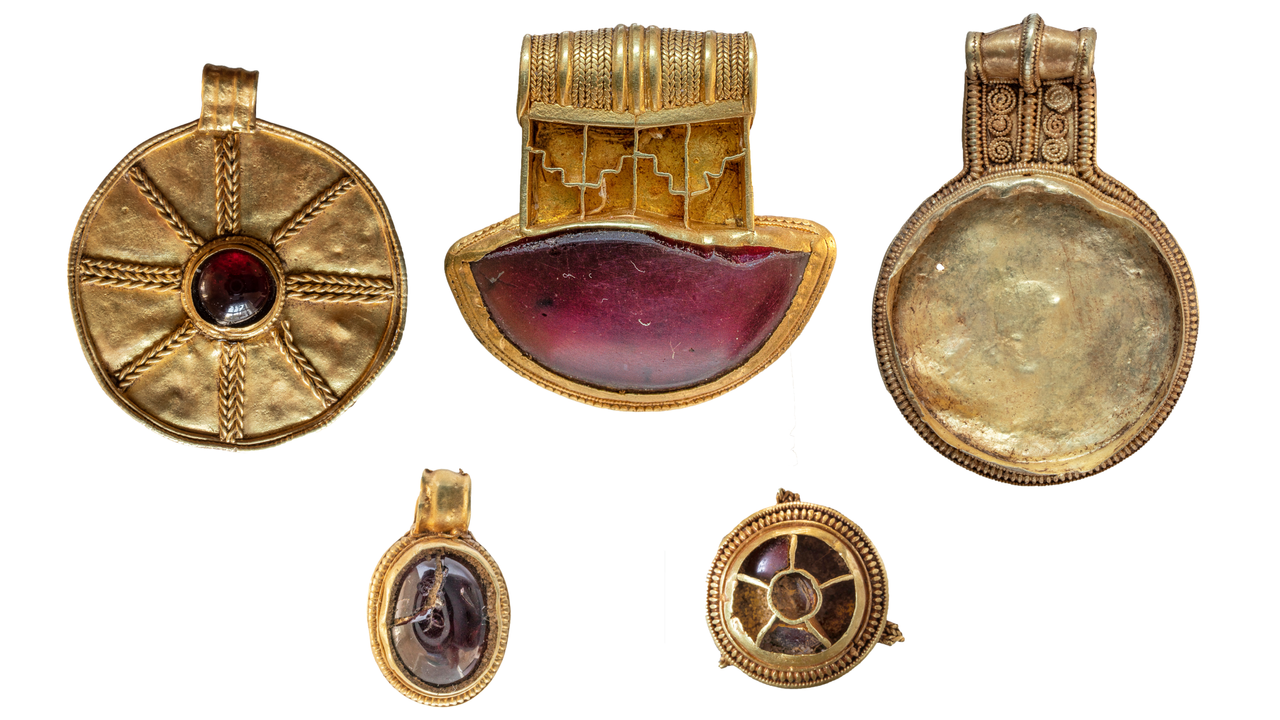
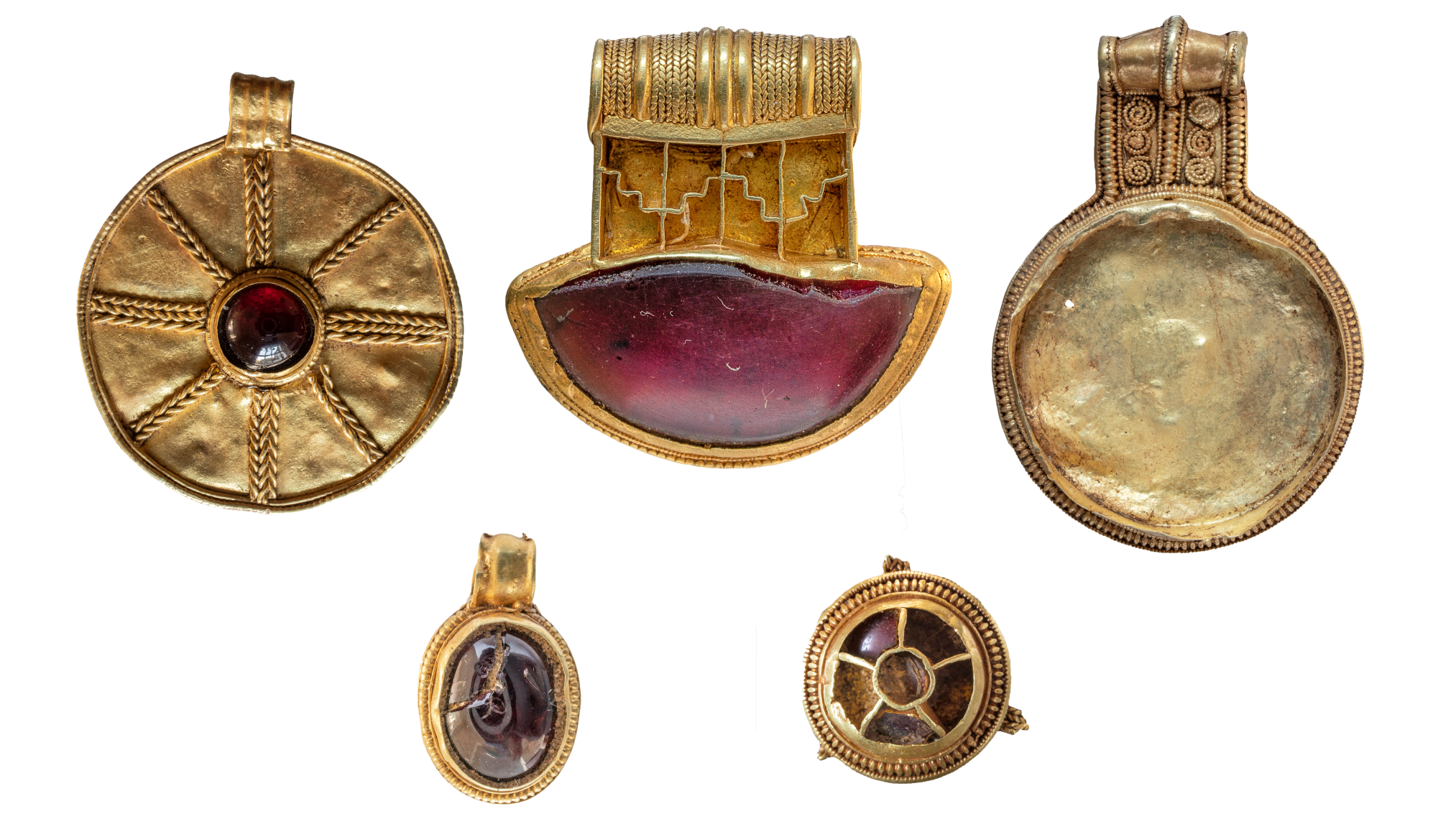 Four gold pendants and one gold-and-garnet brooch dated to the seventh century were discovered in Lincolnshire, England.
(Image credit: The Portable Antiquities Scheme (CC BY 2.0))
Share
Share by:
Four gold pendants and one gold-and-garnet brooch dated to the seventh century were discovered in Lincolnshire, England.
(Image credit: The Portable Antiquities Scheme (CC BY 2.0))
Share
Share by:
- Copy link
- X
Metal detectorists in England have unearthed a spectacular collection of Anglo-Saxon gold-and-garnet pendants that may have ended up in the ground after being ritually "killed" 1,400 years ago.
Two detectorists found the collection of four gold pendants and one piece of a gold brooch on the slope of a hill in the village of Donington on Bain, about 125 miles (200 kilometers) north of London, in the spring of 2023. The detectorists reported their find under the U.K.'s Portable Antiquities Scheme, and archaeologist Lisa Brundle, the finds liaison officer for Lincolnshire county, studied the extraordinary jewels.
You may like-
 'Gold coins started appearing one after another': 1,400-year-old hoard with money and jewelry unearthed near Sea of Galilee
-
 2,000-year-old Celtic teenager may have been sacrificed and considered 'disposable'
-
 Viking Age woman found buried with scallop shells on her mouth, and archaeologists are mystified
While gold-and-garnet pendants were quite common accessories for high-status women in seventh-century England, Brundle wrote, archaeologists typically find them in graves, not in a group on the side of a hill. The pendants also showed signs of wear, damage and modifications, meaning they may have been antiques — at least 60 years old — by the time they were buried.
No other artifacts or human bones were found with the Donington pendants, which suggests that someone may have purposefully collected the accessories and then buried them for safekeeping or in a ritual act, Brundle wrote.
The heaviest artifact in the collection is a D-shaped pendant weighing around 0.2 ounces (6.7 grams). The large garnet is inset into a scallop-shaped gold cell at the bottom of the pendant. "The scallop shape itself is symbolically important," Brundle wrote, "often associated with fertility and potentially bearing Christian connotations."
The other four accessories were all circular with star and beaded motifs. Three of them were pendants, but one was the dome-shaped portion of a brooch that had been extracted for reuse. Reusing the central dome from a brooch is particularly noteworthy, Brundle wrote, because only a dozen or so examples of this exist.
Sign up for the Live Science daily newsletter nowContact me with news and offers from other Future brandsReceive email from us on behalf of our trusted partners or sponsorsBy submitting your information you agree to the Terms & Conditions and Privacy Policy and are aged 16 or over.The Donington group of jewels is unlikely to have been a necklace set from an Anglo-Saxon woman's grave, Brundle noted, because no beads or spacers were found to suggest they had all been strung together. To try and unravel the mystery, Brundle instead sought alternate explanations for why these five items were found in a group.
"One possibility is that the assemblage derives from a smith's hoard," Brundle wrote.
During the seventh century, garnet supplies were dwindling, and an itinerant goldsmith may have collected some antique jewels to modify into new accessories. How the smith collected them is up for debate, though, as grave-robbers are known to have targeted high-status women's graves to remove their prized jewels, Brundle wrote in the study.
You may like-
'Gold coins started appearing one after another': 1,400-year-old hoard with money and jewelry unearthed near Sea of Galilee
-
2,000-year-old Celtic teenager may have been sacrificed and considered 'disposable'
-
Viking Age woman found buried with scallop shells on her mouth, and archaeologists are mystified
Removing the pendants from circulation can also be seen as a kind of "ritual killing," which transformed powerful, antique symbols of elite status into new items no longer connected to those individuals, Brundle noted.
But it is also possible that one or more women simply gathered their own jewelry and hid it away.
"One interpretation is that the assemblage represents the treasured possessions of kin or social groups, deliberately concealed during periods of instability or transition," Brundle wrote.
RELATED STORIES—'I had never seen a skull like this before': Medieval Spanish knight who died in battle had a rare genetic condition, study finds
—Medieval knight 'Lancelot' and his stunning stone tomb found under ice cream shop in Poland
—Metal detectorists unearth dazzling Anglo-Saxon gold-and-garnet raven head and ring: 'It's unbelievable — I'm a bit emotional'
In the late sixth and seventh centuries, the adoption of Christianity changed the social and political context of England, which was split into kingdoms. Lincolnshire was divided into three regions, and the jewelry hoard was found in one of them: Lindsey. While Lindsey was an independent kingdom, it came under the rule of the kingdoms of Northumbria and Mercia at different times during this period, which may have led to instability.
Further archaeological work in the Donington area "may clarify the nature of the site and its potential significance," Brundle wrote, potentially revealing more about the shifting social and political landscape in seventh-century England.
The collection was purchased by the Lincoln Museum in 2025.
Gold and gems quiz: What do you know about sparkly treasures made by nature?
TOPICS gold Kristina KillgroveSocial Links NavigationStaff writer
Kristina Killgrove is a staff writer at Live Science with a focus on archaeology and paleoanthropology news. Her articles have also appeared in venues such as Forbes, Smithsonian, and Mental Floss. Kristina holds a Ph.D. in biological anthropology and an M.A. in classical archaeology from the University of North Carolina, as well as a B.A. in Latin from the University of Virginia, and she was formerly a university professor and researcher. She has received awards from the Society for American Archaeology and the American Anthropological Association for her science writing.
Show More CommentsYou must confirm your public display name before commenting
Please logout and then login again, you will then be prompted to enter your display name.
Logout Read more 'Gold coins started appearing one after another': 1,400-year-old hoard with money and jewelry unearthed near Sea of Galilee
 2,000-year-old Celtic teenager may have been sacrificed and considered 'disposable'
 Viking Age woman found buried with scallop shells on her mouth, and archaeologists are mystified
 Pectoral with coins: 'One of the most intricate pieces of gold jewelry to survive from the mid-sixth century'
 Up to 20,000 coins from Early Middle Ages discovered by man digging for worms near Stockholm
 2,400-year-old 'sacrificial complex' uncovered in Russia is the richest site of its kind ever discovered
Latest in Archaeology
2,400-year-old 'sacrificial complex' uncovered in Russia is the richest site of its kind ever discovered
Latest in Archaeology
 1,400 years ago, Nubians tattooed their toddlers. Archaeologists are trying to figure out why.
 Diarrhea and stomachaches plagued Roman soldiers stationed at Hadrian's Wall, discovery of microscopic parasites finds
 Oldest known evidence of father-daughter incest found in 3,700-year-old bones in Italy
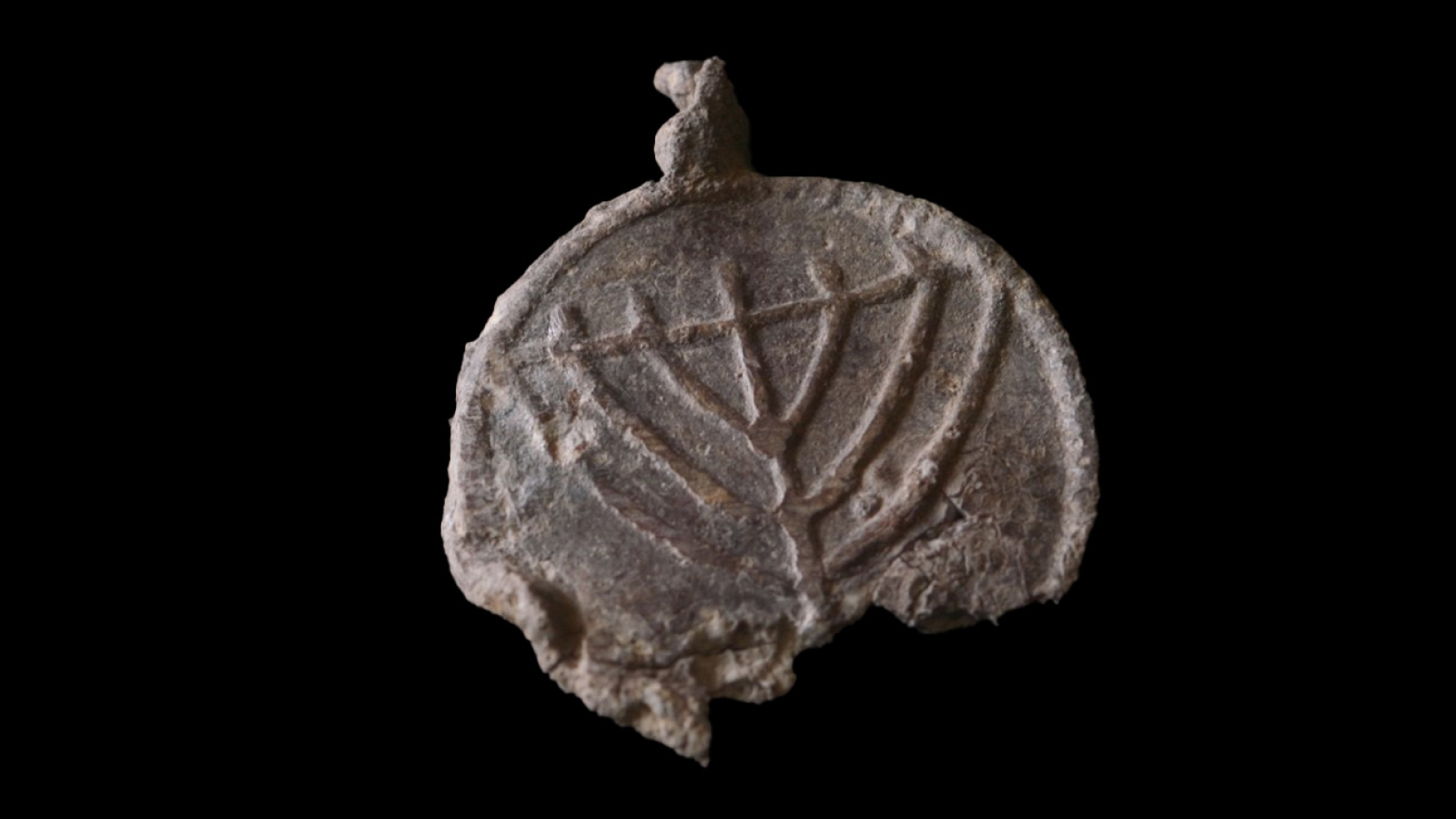 Rare 1,300-year-old medallion decorated with menorahs found near Jerusalem's Temple Mount
 Scientists claim 'Lucy' may not be our direct ancestor after all, stoking fierce debate
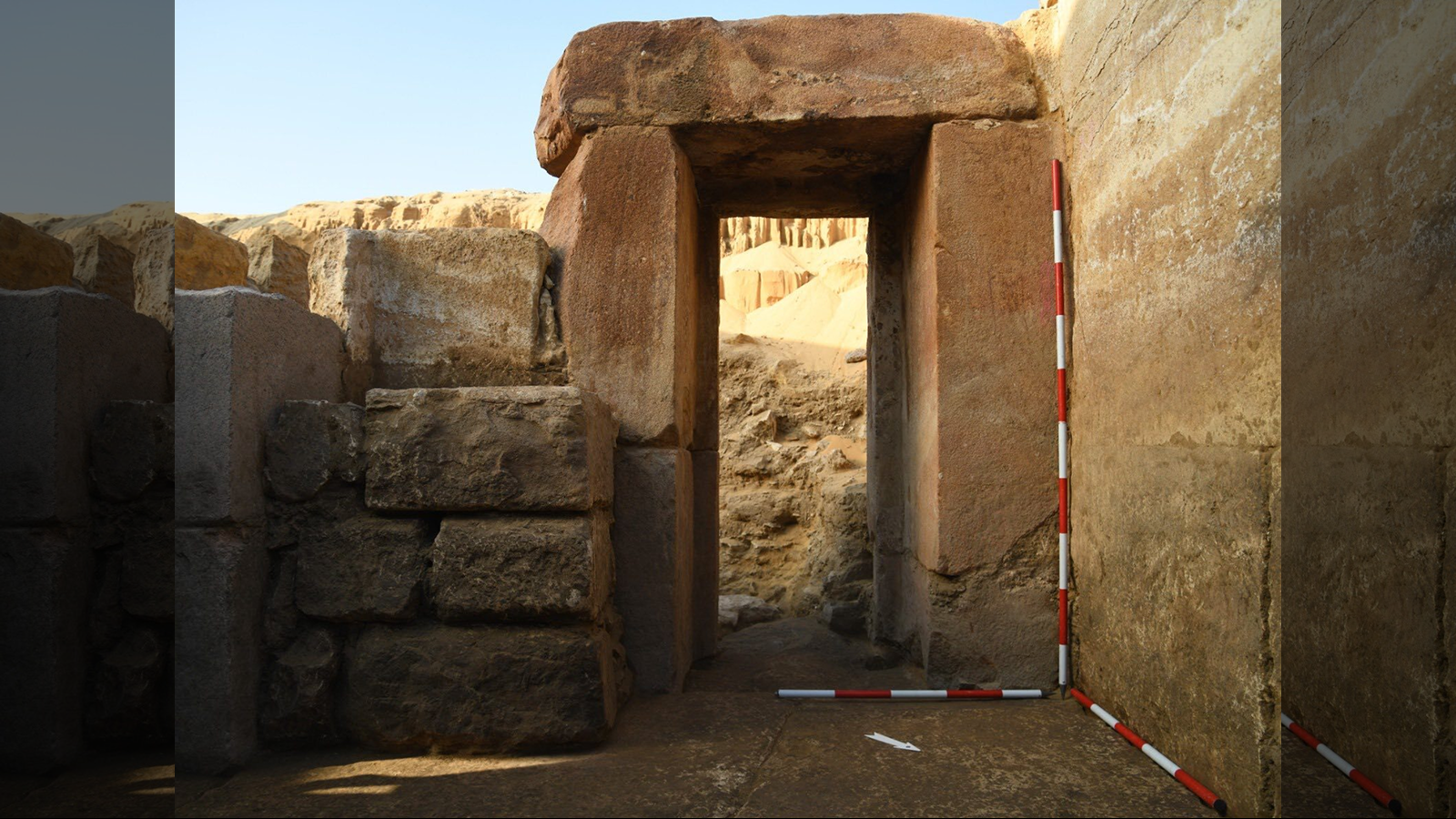 Ancient Egyptian valley temple excavated — and it's connected to a massive upper temple dedicated to the sun god, Ra
Latest in News
Ancient Egyptian valley temple excavated — and it's connected to a massive upper temple dedicated to the sun god, Ra
Latest in News
 Scientists build 'most accurate' quantum computing chip ever thanks to new silicon-based computing architecture
 New EV motor invention could cut 1,000 pounds from future vehicles, making them much lighter while boosting their range
 Japan laser weapon trial, comet 3I/ATLAS bids farewell, and AI solves 'impossible' math problems
 Interstellar comet 3I/ATLAS makes closest pass of Earth. Where's it heading next?
 'Unprecedented' protoplanet collision spotted in 'Eye of Sauron' star system just 25 light-years from Earth
 Comet 3I/ATLAS reaches its closest point to Earth tonight: How to see it
LATEST ARTICLES
Comet 3I/ATLAS reaches its closest point to Earth tonight: How to see it
LATEST ARTICLES- 1Scientists claim 'Lucy' may not be our direct ancestor after all, stoking fierce debate
- 2New EV motor invention could cut 1,000 pounds from future vehicles, making them much lighter while boosting their range
- 3Reliquary of the Holy Crib: Remains of Jesus' manger from Bethlehem
- 4The self-gifter's Christmas: Treat yourself to gear you'll actually want this Christmas
- 5Glittering new James Webb telescope image shows an 'intricate web of chaos' — Space photo of the week