- Health
- Mind
- Neuroscience
By directly communicating with the brain, a new wireless device could someday help restore lost senses or manage pain without medications, its developers say.
When you purchase through links on our site, we may earn an affiliate commission. Here’s how it works.
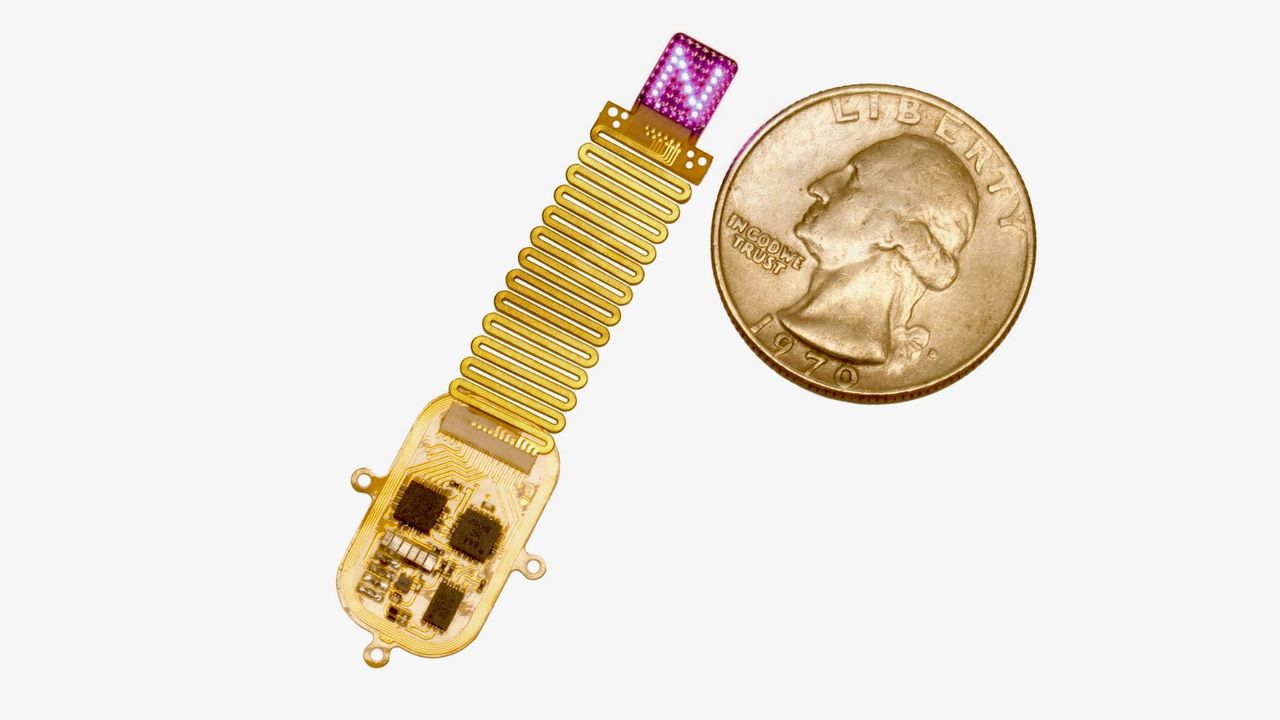
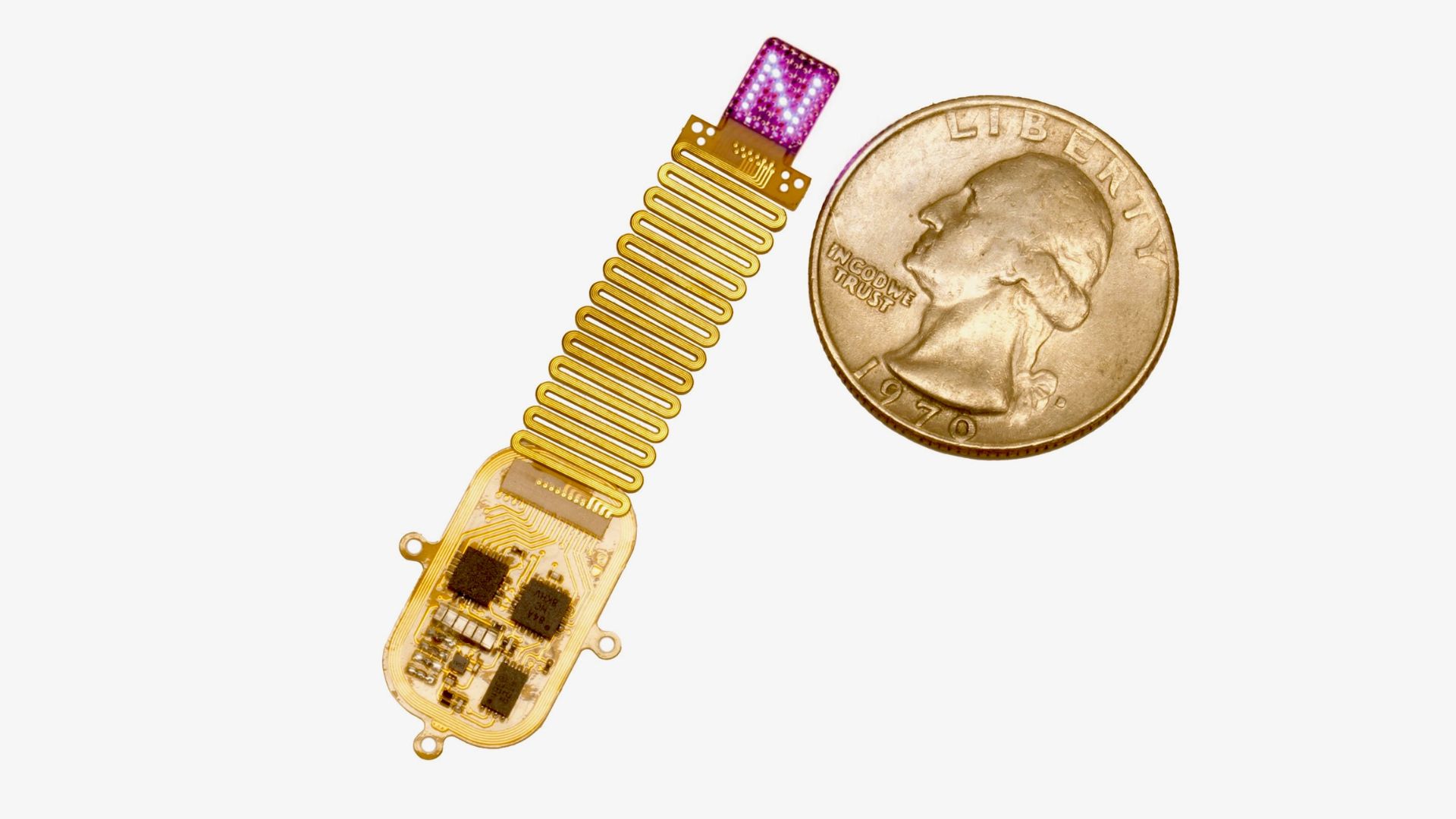 A small device (left) is designed to be implanted under the skin of the scalp and deliver LED light into the brain tissue beneath.
(Image credit: Mingzheng Wu/Rogers Research Group)
Share
Share by:
A small device (left) is designed to be implanted under the skin of the scalp and deliver LED light into the brain tissue beneath.
(Image credit: Mingzheng Wu/Rogers Research Group)
Share
Share by:
- Copy link
- X
A new brain-machine interface (BMI) uses light to "speak" to the brain, mouse experiments show.
The minimally invasive wireless device, which is placed under the scalp, receives inputs in the form of light patterns, which are then conveyed to genetically modified neurons in brain tissue.
In the new study, these neurons activated as if they were responding to sensory information from the mice's eyes. The mice learned to match these different patterns of brain activity to perform specific tasks — namely, to uncover the locations of tasty snacks in a series of lab experiments.
You may like-
 New eye implants combined with augmented-reality glasses help blind people read again in small trial
-
 Scientists used AI to map uncharted areas of the mouse brain
-
 Scientists create world's first microwave-powered computer chip — it's much faster and consumes less power than conventional CPUs
The device marks a step toward a new generation of BMIs that will be capable of receiving artificial inputs — in this case, LED light — independent of typical sensory channels the brain relies on, such as the eyes. This would help scientists build devices that interface with the brain, without requiring trailing wires or bulky external parts.
"The technology is a very powerful tool for doing fundamental research," and it could address human health challenges in the longer term, said John Rogers, a bioelectronics researcher at Northwestern University and senior author of the study, which was published Dec. 8 in the journal Nature Neuroscience.
Bypassing the sensory system
The device, which is smaller than a human index finger, is soft and flexible, so it conforms to the curvature of the skull. It includes 64 tiny LEDs, an electronic circuit that powers the lights, and a receiver antenna. Additionally, an external antenna controls the LEDs using near-field-communications (NFC) — electromagnetic fields for short-range communications as is done for contactless card payments.
The compact device is designed to be placed under the skin, rather than being implanted directly into the brain. "It projects light directly onto the brain [through the skull], and the response of the brain to that light is generated by a genetic modification in the neurons," Rogers told Live Science.
Sign up for the Live Science daily newsletter nowContact me with news and offers from other Future brandsReceive email from us on behalf of our trusted partners or sponsorsBy submitting your information you agree to the Terms & Conditions and Privacy Policy and are aged 16 or over.Brain cells don't normally respond to light that is shone on them, so gene editing is required to make that happen.
"The genetic modification creates light-sensitive ion channels," Rogers explained. When activated by light, these channels allow charged particles to flow into brain cells, tripping a signal that then gets sent to other cells. "Through that mechanism, we create light sensitivity directly in the brain tissue itself," he said. The genetic modification of the brain cells was done using a viral vector, a harmless virus made to deliver the desired genetic tweak into specific cells in different regions of the brain.
The use of light to control the activity of genetically modified cells is called optogenetics, and it's a relatively new science. In past work, the researchers used a similar approach to activate just one group of brain cells, but the new device enabled them to toggle the activity of many neurons across the brain.
You may like-
New eye implants combined with augmented-reality glasses help blind people read again in small trial
-
Scientists used AI to map uncharted areas of the mouse brain
-
Scientists create world's first microwave-powered computer chip — it's much faster and consumes less power than conventional CPUs
"[The genetic modification] is not just stimulating the part of the brain that's naturally responsible for visual perception, but across the entire surface of the cortex," Rogers said. Thus, sending different patterns of illumination creates a corresponding distribution of neural activity. "It's like we can project a series of images — almost like play a movie — directly into the brain by controlling [the] sequence of patterns."
RELATED STORIES—New 'thought-controlled' device reads brain activity through the jugular
—New brain implant can decode a person's 'inner monologue'
—Brain-computer interface helps patient with locked-in syndrome communicate
The researchers tested the implant in the mice by wirelessly instructing it to produce various patterned bursts of light. The mice were trained to respond to each pattern with a specific behavior, indicating that they could distinguish between the patterns transmitted. With each type of signal, they had to go to a specific cavity in a wall, and for choosing correctly, they'd get sugar water as a reward.
Bin He, a neuroengineering researcher at Carnegie Mellon University who wasn't involved in the study, called it a novel technique for using light to tune circuits across the brain. "It may have various applications in neuroscience research using animal models … and beyond," he said.
For instance, the researchers see potential for this device in future prosthetics. Applications could include adding sensations, like touch or pressure, to prosthetic limbs, or sending visual or auditory signals to vision or hearing prostheses.
"Optogenetic techniques are just beginning to be used with humans," Rogers said. "There are tremendous advantages [to using light] because you don't need to disrupt the brain tissues. You can use different wavelengths of light to control different regions of the brain."
Rogers said that from a technology standpoint, the platform could scale to cover much larger areas of the brain and contain more micro-LEDs. However, they would have to rethink the power-supply requirements to support a larger device. It should technically work in humans as it does in mice, but further research will be needed before any tests are attempted in humans.
"The biggest hurdle is around the regulatory approval for the genetic modification," he said.
Brain quiz: Test your knowledge of the most complex organ in the body
 Payal DharLive Science Contributor
Payal Dhar (she/they) is a freelance journalist, writing on science, technology, and society. They cover AI, engineering, materials science, cybersecurity, space, games, online communities, and any shiny new technology that catches their eye. She has written for Science News, Scientific American, Nature, Washington Post, Guardian, Chemical & Engineering News, IEEE Spectrum, and others. They also write science-fiction and fantasty. You can follow her @payaldhar.bluesky.social or read her work at payaldhar.contently.com.
Show More CommentsYou must confirm your public display name before commenting
Please logout and then login again, you will then be prompted to enter your display name.
Logout Read more New eye implants combined with augmented-reality glasses help blind people read again in small trial
 Scientists used AI to map uncharted areas of the mouse brain
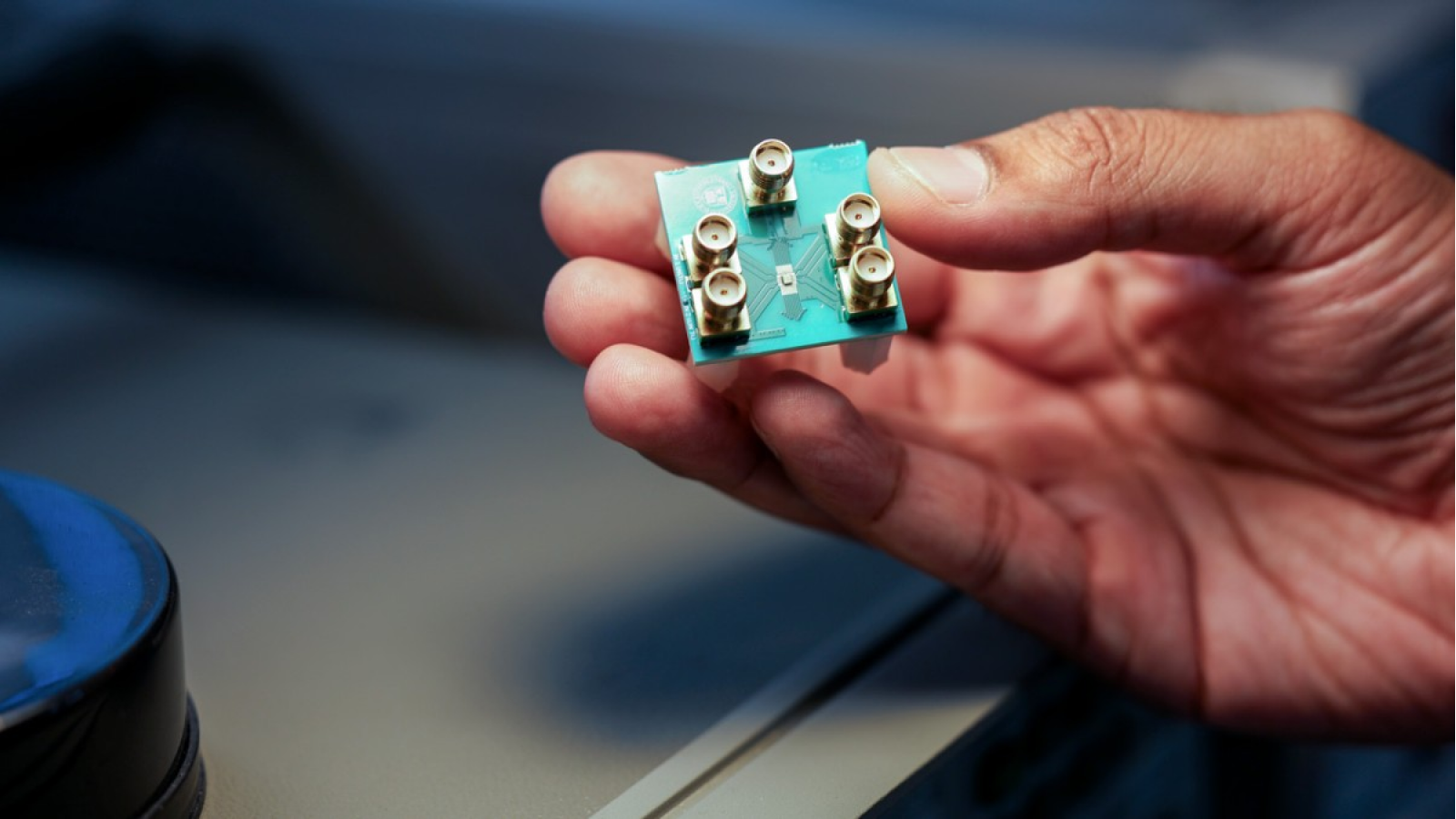 Scientists create world's first microwave-powered computer chip — it's much faster and consumes less power than conventional CPUs
 Scientists say they've eliminated a major AI bottleneck — now they can process calculations 'at the speed of light'
 'As if a shudder ran from its brain to its body': The neuroscientists that learned to control memories in rodents
 Injecting anesthetic into a 'lazy eye' may correct it, early study suggests
Latest in Neuroscience
Injecting anesthetic into a 'lazy eye' may correct it, early study suggests
Latest in Neuroscience
 Brain scans reveal 'dial' that helps keep us from getting lost
 'Intelligence comes at a price, and for many species, the benefits just aren't worth it': A neuroscientist's take on how human intellect evolved
 The evolution of life on Earth 'almost predictably' led to human intelligence, neuroscientist says
 CTE may stem from rampant inflammation and DNA damage
'As if a shudder ran from its brain to its body': The neuroscientists that learned to control memories in rodents
CTE may stem from rampant inflammation and DNA damage
'As if a shudder ran from its brain to its body': The neuroscientists that learned to control memories in rodents
 New study reveals why time seems to move faster the older we get
Latest in News
New study reveals why time seems to move faster the older we get
Latest in News
 Cats meow more at men to get their attention, study suggests
 2,300-year-old Celtic gold coins found in Swiss bog
Tiny implant 'speaks' to the brain with LED light
2,300-year-old Celtic gold coins found in Swiss bog
Tiny implant 'speaks' to the brain with LED light
 3,300-year-old cremations found in Scotland suggest the people died in a mysterious catastrophic event
 'A huge surprise': 1,500-year-old church found next to Zoroastrianism place of worship in Iraq
 NASA spacecraft takes milestone 100,000th image of Mars (photo)
LATEST ARTICLES
NASA spacecraft takes milestone 100,000th image of Mars (photo)
LATEST ARTICLES- 1Cats meow more at men to get their attention, study suggests
- 2See the 100,000th photo of Mars taken by NASA's groundbreaking Red Planet orbiter
- 3'A huge surprise': 1,500-year-old church found next to Zoroastrianism place of worship in Iraq
- 4Graphene supercapacitor breakthrough could boost energy storage in future EVs and other household devices
- 5Rare dusting of snow covers one of the driest places on Earth and shuts down massive radio telescope — Earth from space