
After raining thousands of bombs on Iran, the United States and Israel are outsourcing the task of overthrowing the government to civilians who are unarmed and otherwise ill-equipped to take on the heavily armed oppressive forces they would face.
US President Donald Trump and Israel’s Prime Minister Benjamin Netanyahu both urged workaday Iranians to rise up. The task was described as a now-or-never opportunity that will follow the forcible disarming of the Islamic Republic.
“When we are finished, take over your government. It will be yours to take,” Trump said in a video message. “It will be probably your only chance for generations.”
Netanyahu, who during his 30-year political career has identified Iran as a prime source of regional antagonism to the Jewish state, described the occasion as “a once in a lifetime opportunity.”
“Soon, there’s going to be a moment that you’ll have to go to the streets to complete this act and to topple this regime.”
The sales pitch by Trump and Netanyahu seemed to ignore a reality facing the Iranian population: no nationwide organization exists to take on such a task, dissident groups lack weapons and are up against the government’s 150,000-member Islamic Revolutionary Guard Corps, the enforcer of obedience to the regime.
The Revolutionary Guards put their fearsome talents on display by shooting down tens of thousands of protestors during nationwide demonstrations that broke out last December and continued into January.
The intense US and Israeli bombing campaign on display during the first four days of the current war is unlikely to have produced a big chance for civilians to take to the streets.
Latest stories

Hormuz doesn’t need to close to cripple Asia’s economies

EU’s burial in a Belgian castle
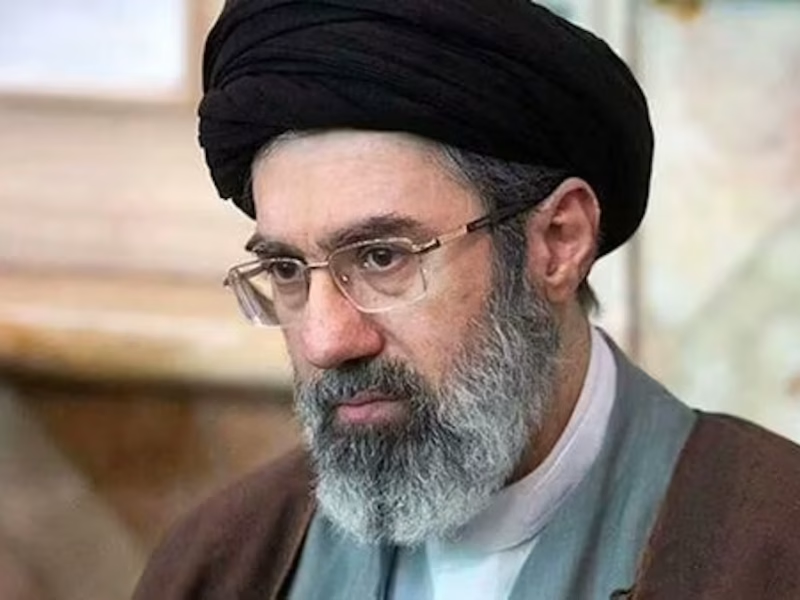
Breaking: Khamenei son reportedly named Iran’s new supreme leader
“First, an armed bombing campaign has never in history incited a successful uprising against the government,” Daniel Block, senior editor of Foreign Affairs magazine, told Canadian Broadcasting. “It’s incredibly difficult to actually bomb out all the state’s repressive capacity.”
For the US and Israel to provide a chance for success, Block added, “You need to have troops on the ground.”
Short memories could explain Washington’s failure to understand why workaday Iranians decline to act. In February, 1991, then-US President George H.W. Bush – having liberated Kuwait from an Iraqi invasion – urged the population of Iraq to overthrow Saddam Hussein, a dictator who was an ardent practitioner of violent oppression.
Bush encouraged “the Iraqi military and the Iraqi people to take matters into their own hands and force Saddam Hussein to step aside.” Western air force crews dropped leaflets from the air calling on Iraqis to “Fill the streets and alleys and bring down Saddam Hussein and his aides.”
Kurdish citizens in northern Iraq began assaulting Saddam associates. So did even more numerous Shiite Muslims in the south. Believing that all this was a sign that the Saddam era was over, General Norman Schwarzkopf, the top US military commander in Iraq, permitted remnants of the Iraqi army to fly helicopters all over the country on supply runs.
Saddam’s loyalists used the helicopters, along with their own armed vehicles and cannons, to put down the rebellions. Some 60,000 Shiites were slaughtered along with 20,000 Kurds.
Rather than focusing on avoiding a similar blunder, Trump and his advisors seem fixated on a different faulty decision made in 2003. President George W. Bush, the first Bush’s son, ordered an invasion of Iraq on the false accusation that Saddam, still in power, had secretly developed weapons of mass destruction. No such weaponry was ever found.
The invasion turned into an eight-year occupation overflowing with attacks on US and allied forces by both Iraqi Islamic nationalists and Iranian-trained militiamen and terrorists.
Trump interprets that experience, as well as America’s 20-year occupation of Afghanistan, as “forever wars” to be avoided. That means letting the Iranians themselves do the messy work of regime change. If they fail, it’s their fault.
In any case, Trump has not promised to overthrow the Iranian government, but rather, “to defend the American people by eliminating imminent threats from the Iranian regime.”
“We are going to destroy their missiles and raze their missile industry to the ground. It will be totally … obliterated. We’re going to annihilate their navy,” Trump said in a video from his Florida beachfront mansion and resort, from where he launched the war.
In Washington, Secretary of State Marco Rubio translated the stew of words as meaning: Iran will never be allowed to develop either nuclear weapons or long-range missiles that can carry them.
While promising to defang the Iranian military’s ambitions, Trump also said he is willing to talk about things, further throwing into doubt any ambition he might have had to oust the Islamic government from power.

Sign up for one of our free newsletters
- The Daily Report Start your day right with Asia Times' top stories
- AT Weekly Report A weekly roundup of Asia Times' most-read stories
Trump appears to be trying to apply the policy he is carrying out in Venezuela, whose President Nicolas Maduro was corralled by a US team that raided Caracas and ferried the leader to jail in New York on drug-trafficking charges. The government and institutions left behind are still at work, albeit under the thumb of a watchful Rubio and a team of viceroys.
Critics say that the Venezuela model is not applicable to Iran. The Revolutionary Guard, created more than four decades ago, has grown into an all-encompassing internal and external security force responsible for political control, border defense and the operation of Iran’s ballistic missile units.
The Guard Corps is also in charge of Iran’s blocking of the Strait of Hormuz, the narrow entrance to the Persian Gulf. Oil shipments through the Strait account for 31% of global supplies, with most of the traffic routed to Asian countries.
“Iran’s expansive security organizations are not waiting to find out what Trump has in mind,” says an analysis published online by NDTV, a television network based in India. “It has invested heavily in asymmetric warfare: ballistic missiles, drones, naval mines and cyber operations. Its ability to disrupt shipping in the Strait of Hormuz … gives it leverage that Venezuela never possessed.”
Sign up here to comment on Asia Times stories
Sign in with Google Or Sign up Sign in to an existing account
Thank you for registering!
An account was already registered with this email. Please check your inbox for an authentication link.

Daniel Williams
Daniel Williams is a former foreign correspondent for The Washington Post, Los Angeles Times and Miami Herald and an ex-researcher for Human Rights Watch. His book Forsaken: The Persecution of Christians in Today’s Middle East was published by O/R Books. He is currently based in Rome.
More by Daniel Williams